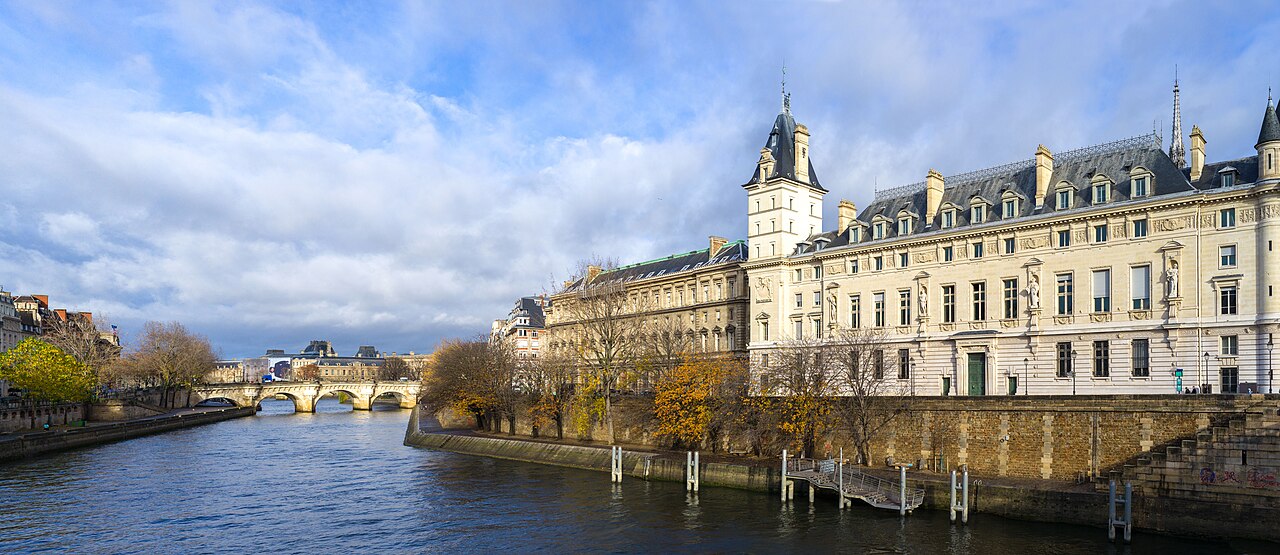
Why Paris Needed a New Bridge
By the late sixteenth century, Paris relied on congested medieval bridges crowded with timber houses that blocked light, airflow and floodwater. Fires and collapses had repeatedly devastated older crossings.
Henri IV commissioned the Pont Neuf as part of a broader programme to modernise the capital, improve trade routes and symbolise royal reconciliation after the Wars of Religion.
Design and Construction
Engineers Baptiste Androuet du Cerceau and Guillaume Marchand designed a stone arch bridge in two spans — twelve arches on the Right Bank side and seven on the Left — meeting on the downstream tip of Île de la Cité.
Unlike earlier bridges, no structures were permitted on the roadway. Wide pavements, a raised carriageway and semicircular bastions at each pier created public space with unobstructed river panoramas.
Public Life on the Bridge
The Pont Neuf quickly became a social stage — vendors, tooth-pullers, charlatans and early print sellers gathered on its pavements. Chroniclers described it as a theatre of Parisian street culture through the seventeenth and eighteenth centuries.
The bridge's open design influenced later Seine crossings and helped establish the quays as promenade space rather than purely commercial waterfront.
Stand on the downstream bastions at sunset for views toward the Institut de France and Louvre — the alignment Henri IV's planners intended as a ceremonial approach to the royal city.
Floods, Repairs and Modernisation
Major Seine floods in 1658, 1910 and more recent high-water events have tested the bridge's foundations. Nineteenth-century engineers reinforced piers and adjusted parapets as river traffic shifted from cargo barges to leisure craft.
Today the Pont Neuf carries road traffic, pedestrian flows and serves as a landmark for river tour boats including Vedettes du Pont Neuf operators based nearby.
Heritage Significance Today
Classified as a monument historique, the Pont Neuf remains the oldest bridge in Paris still in its original form. It frames the western gateway to Île de la Cité and connects visitors to two millennia of island history.
- Construction completed 1607 under Henri IV
- First Paris bridge without houses on the deck
- Twelve arches (north) and seven arches (south)
- Equestrian statue of Henri IV at the island centre