Medieval Royal Palace
Capetian kings held court in the Grand'Salle and adjacent chambers, administering justice as a royal prerogative. The Conciergerie's surviving vaulted halls illustrate the scale of palace service wings.
Sainte-Chapelle and the palace formed an integrated complex where sacred legitimacy and secular judgment reinforced each other.
Revolution and the Conciergerie
During the Terror, the Conciergerie became a notorious detention centre. Marie-Antoinette and thousands of others passed through its cells before trial at the Revolutionary Tribunal seated in the palace.
Exhibits today interpret prison conditions, tribunal procedure and the compression of justice into expedited political trials.
Nineteenth-Century Reconstruction
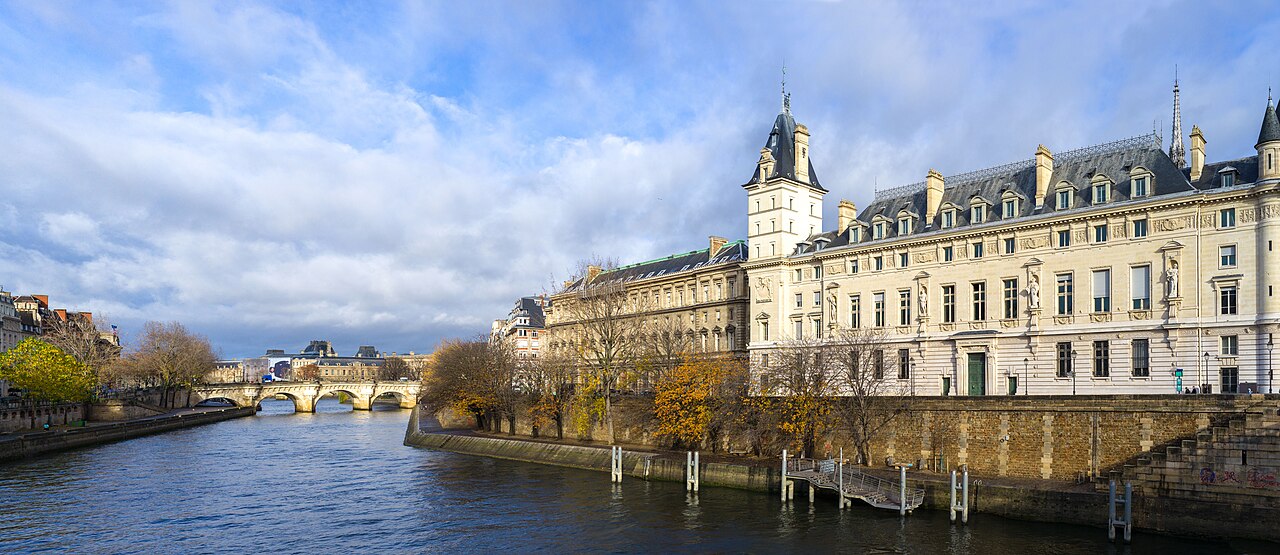
Fires and successive regimes remodelled the palace. Napoleon III's expansion added the imposing neoclassical facade visible from the Seine, signalling state authority to citizens and river traffic alike.
Active court business means portions of the Palais remain closed to tourists. Public visits concentrate on the Conciergerie monument and scheduled heritage openings.
Judicial Functions Today
The Cour de cassation, Cour d'appel de Paris and Tribunal de commerce maintain the island as France's legal heart. Lawyers, plaintiffs and journalists circulate daily beneath roofs that once sheltered kings.
Debates over overcrowding, accessibility and heritage preservation influence long-term plans to modernise court facilities while protecting medieval fabric.
Architectural Reading
Compare the palace's fortress-like riverside massing with the lace Gothic of neighbouring Sainte-Chapelle — a dialogue between opaque power and translucent sacred narrative on a single island block.